By Ali R Ali Jigawa
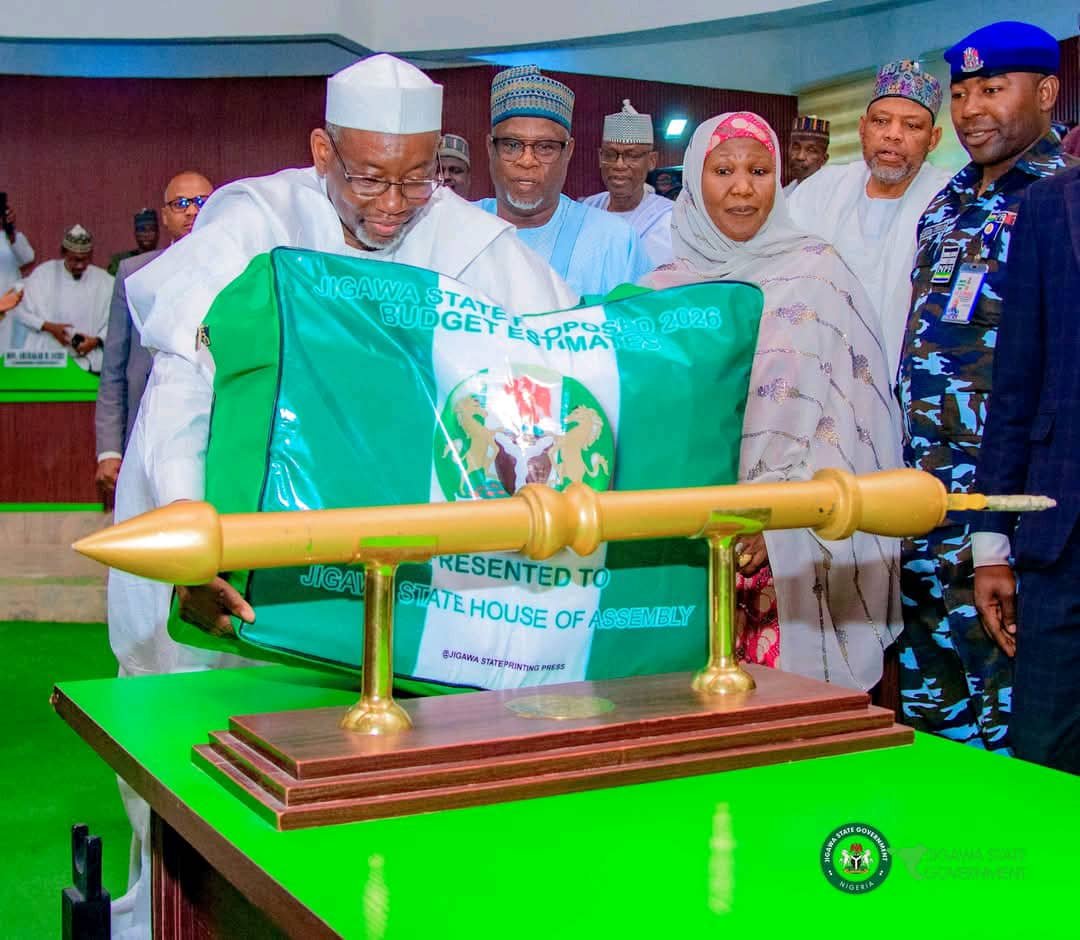
Governor Malam Umar Namadi of Jigawa State has presented the 2026 Appropriation Bill to the State House of Assembly with a total proposed expenditure of ₦901.8 billion, signalling a significantly expanded capital development agenda for the 2026 fiscal year.
The governor described the proposal as an ambitious yet achievable plan aimed at consolidating progress already recorded and accelerating development across key sectors of the state’s economy.
In his presentation, Governor Namadi explained that the proposed budget reflects a 19.2% increase over the 2025 appropriation of ₦756.3 billion, which reflects the administration’s commitment to sustained investment in critical infrastructure, agricultural modernization, energy expansion, education, health, and social development.
Read also: Jigawa state gov’ approves ₦7.2 billion projects to boost economy, security, and infrastructure
He stated that the budget is anchored on the state’s long-term vision as articulated in the 12-Point Agenda and the recently approved Comprehensive Development Framework.
The governor outlined the budget’s revenue structure, projecting the total ₦901.8 billion from the following sources: ₦96.2 billion from Statutory Allocation, ₦102 billion from VAT, ₦223 billion from other federal transfers, ₦88.9 billion in Internally Generated Revenue, ₦42 billion from LEA and PHC reimbursements, and ₦349.5 billion as capital receipts from opening balance, loans, and grants.
He explained that these figures were carefully considered and validated to ensure a realistic and credible financing framework for the budget.
Governor Namadi stated that the expenditure structure of the budget reflects the administration’s determination to prioritize long-term development over recurrent commitments, as a total of ₦693.4 billion, representing 76.9% of the budget, is earmarked for capital investments, while the remaining expenditures cover ₦120 billion for personnel costs, ₦75.6 billion for overheads and other recurrent needs, ₦7 billion for contingency and stabilization, and ₦5.7 for public debt charges.
Presenting the sectoral allocations, the governor explained that the economic sector—which includes roads, agriculture, power, commerce, investment promotion, and youth empowerment—received more than ₦396 billion, which includes ₦186.3 billion for roads and transport development, ₦74.9 billion for agriculture and livestock, ₦50.7 billion for power and energy, ₦17.5 billion for commerce and investments, ₦17.4 billion for strategic investments, and ₦12.6 billion for youth empowerment and employment generation.
He stated that these investments are designed to enhance connectivity, boost agricultural productivity, facilitate energy reliability, expand market systems, and create jobs for the growing youth population.
The social sector also received substantial allocations, totalling more than ₦236 billion, with education and health taking prominent positions, as the budget provides ₦48.2 billion for basic education, ₦52.3 billion for post-basic education, ₦38.6 billion for tertiary education, ₦27.2 billion for the Ministry of Health, ₦20.1 billion for the Primary Health Care Development Agency, and ₦13.9 billion for women’s affairs and social development, while the Information, Youth, Culture, and Sports sector is allocated ₦2.8 billion.
Governor Namadi emphasized that the combined allocations for education and health exceed ₦310 billion, reinforcing the centrality of human capital development in the state’s growth strategy, just as he further highlighted the allocations made to strengthen water supply, environmental protection, and urban development.
These include ₦25.4 billion for water supply and sanitation, ₦35.4 billion for environmental protection and climate resilience, ₦7.9 billion for land, housing, and urban development, and ₦2.3 billion for local governance and community development.
These investments will support access to clean water, erosion control programmes, mitigation of climate-related risks, and improvements in regional and urban planning.
Alongside the state budget, Governor Namadi also presented the consolidated budget of the 27 local government councils, amounting to ₦288,848,892,051, with ₦68,884,969,458 going to personnel costs, ₦74,265,000,320 to overheads, ₦8,100,000,000 to contingency, and ₦137,598,273,000 to capital expenditure.